TL;DR
A customer sees your product in a 15-second reel. Five years ago, here's what happened next: they'd note your brand, open a browser, type your name, land on a homepage, hunt through a menu, find the product, squint at the size chart, get a "create an account" popup, abandon the cart, and forget you existed by dinner.
A customer sees your product in a 15-second reel. Five years ago, here's what happened next: they'd note your brand, open a browser, type your name, land on a homepage, hunt through a menu, find the product, squint at the size chart, get a "create an account" popup, abandon the cart, and forget you existed by dinner.
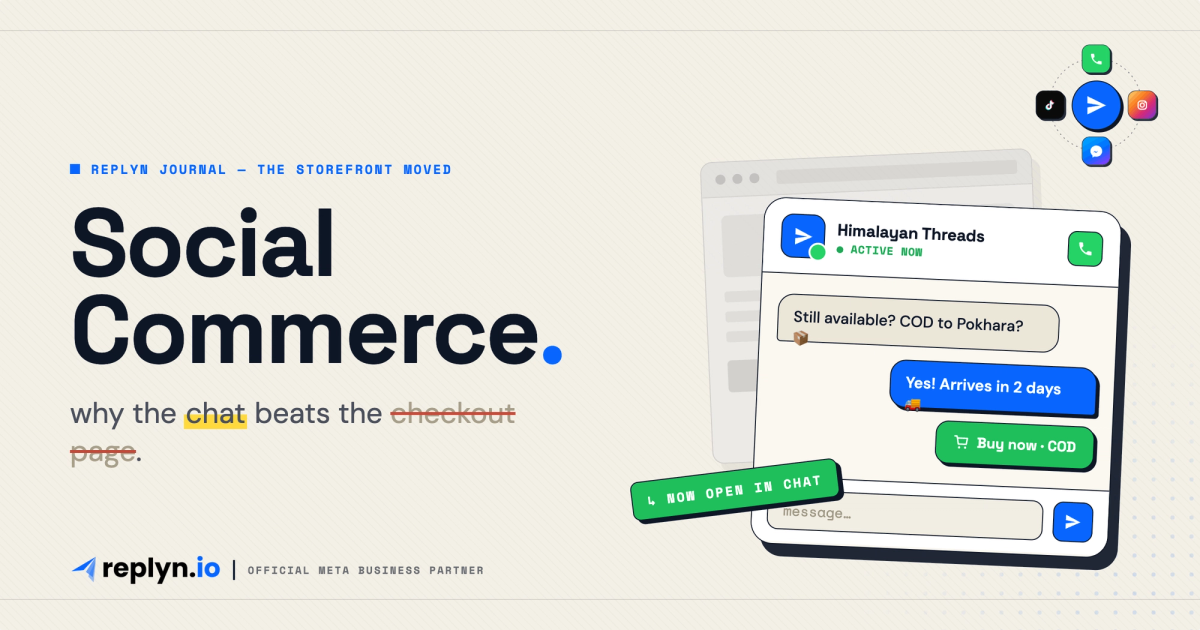
Here's what happens now: they tap the comment that says "how much?", you reply in the DM, they ask about delivery to Pokhara, you send a photo of the actual product, they say "okay I'll take it, COD," and it's sold. No website. No homepage. No cart.
That second journey is social commerce. And it's quietly eating the first one alive. The global social commerce market is worth around $2.1 trillion in 2026 and growing over 26% a year — roughly three times faster than traditional ecommerce. In the same year, social commerce will account for more than a fifth of all ecommerce on earth, up from 17% just a year before.
The shop didn't disappear. It moved into the place people already spend two and a half hours a day. Here's why that happened — and why the chat, not the checkout page, is now where money is made.
Why the traditional website is getting overtaken
The website was built on an assumption that's quietly stopped being true: that people want to go somewhere to shop.
They don't anymore. A website asks the customer to leave the app they're enjoying, load a new page, learn a new menu, and trust a brand they met eight seconds ago — enough to type their card number into a form. Every one of those steps is a door, and at every door, people leave.
The numbers are blunt about it. Around 70% of Gen Z now prefer to buy directly inside a social app rather than get bounced to an external website. And 81% of people research a product on social media before they buy it — meaning the discovery, the reviews, the "is this legit," and increasingly the purchase itself all happen in one place, without a browser tab ever opening.
This is why platform conversion rates tell such a lopsided story. A traditional product page converts at the familiar 2–3%. A TikTok Shop checkout converts near 4.7%. A live shopping session can convert as high as 30%. The closer the "buy" sits to the moment of desire — and the fewer doors between them — the more people walk through.
A website is a destination you hope people visit. Social commerce is a conversation that meets them where they already are. In 2026, distance is the enemy, and the website is the longest walk in retail.
Why people need to talk to buy things
Here's the part the spreadsheet-brained version of ecommerce missed for two decades: buying is emotional, and emotions need answers.
Think about how anyone actually buys something that matters to them. They have a question. Will this fit? Is the colour like the photo? Do you deliver to my area? Can I pay cash on delivery? Is this the real product or a copy? A website answers none of these in the moment — it just sits there with a static FAQ page nobody reads. A conversation answers all of them in thirty seconds, and in doing so, it does something a homepage can never do: it builds trust.
That's the engine under conversational commerce — a market on its own track toward roughly $14 billion in 2026. People don't want to fill out a form. They want to be helped. A chat replaces the cold transaction with something that feels like walking into a shop and having someone who knows the product look you in the eye.
In markets built on cash-on-delivery — Nepal very much included — this isn't a nice-to-have, it's the whole sale. A COD order placed by a stranger on a website is a coin flip; half of them ghost the delivery rider. A COD order confirmed in a conversation — "Yes, send it, I'll be home after 5" — is a real sale, because a human said yes to another human. The chat doesn't just close the deal. It filters out the fake ones before you pay to ship them.
People don't buy from storefronts. They buy from someone who answered them.
The algorithm grew up — and it's frighteningly good at finding your buyer
For years, "targeting" meant you did the work. You'd stack interests, layer demographics, guess at lookalike percentages, and hope you'd drawn the box around the right people. It was manual, it was a guess, and after Apple's 2021 privacy changes gutted the tracking signal, a lot of that guessing stopped working.
So Meta rebuilt the whole machine. The granular targeting that defined Facebook ads for a decade is being retired on purpose. In its place sits an AI delivery system — Advantage+, running on Meta's Andromeda engine — that does something genuinely new: you hand it your product, your creative, and your budget, and it finds the buyer across Facebook, Instagram, Messenger, and WhatsApp. You don't define the audience. The algorithm pinpoints it, tests it, and reallocates your money to whatever's converting, in real time, while you sleep.
This isn't a marginal upgrade. Advantage+ campaigns now make up around 62% of ecommerce ad spend on the platform and deliver roughly 22% higher return than the old manual setups. The lever of the entire game has moved: it used to be who you target; now it's the quality of your creative and the strength of your customer signals. The machine handles the aim. You handle the message.
And here's the move that ties this whole piece together. The single sharpest tool in that arsenal is the Click-to-WhatsApp (or Click-to-Messenger) ad. Instead of sending a high-intent stranger to a website to get lost, the ad drops them straight into a conversation with you. Meta's AI finds the person most likely to want your product — and then, instead of a landing page, hands you a live chat with them. The most efficient ad on earth, opening directly into the one place people actually buy: the inbox.
Which raises the only question that matters next.
Can you actually handle the conversations?
This is where most businesses break.
The algorithm is brilliant at starting conversations. It will flood you with them. But an ad that delivers fifty DMs by 9 a.m. is worthless if the first reply goes out at 4 p.m. — by then the buyer has scrolled on, asked a competitor, or simply lost the urge. In conversational commerce, speed is the conversion. A question answered in thirty seconds is a sale. The same question answered in three hours is a refund you never got to issue.
And it's not one inbox. It's four. A modern brand is fielding questions on WhatsApp, Instagram, Messenger, and TikTok at the same time — different tabs, different logins, different notification sounds, leads slipping through every crack between them.
That's the exact gap Replyn is built to close.
Replyn Inbox pulls every conversation — WhatsApp, Instagram, Messenger, TikTok — into one screen. One queue, one team, nothing lost between platforms. The ad spend that the algorithm optimised so carefully finally lands somewhere that can actually catch it.
Replyn AI makes sure the reply never comes late. It answers instantly, around the clock — fielding the "how much," the "do you deliver here," the "is this in stock" — in your brand's voice, and hands off to a human the moment the conversation needs one. Your fastest salesperson, awake at 2 a.m., never tired, never missing a message.
The storefront moved into the chat. The algorithm got good enough to fill that chat with the right people. The only thing left to decide is whether someone — or something — is there to answer when they arrive.
See what your inbox looks like when nothing slips through. Talk to the Replyn team →
Kshitij Subedi
Founder. Replyn